Twizu: AI Operational Intelligence.
AIOI → Understand → Evaluate → Better AI Decisions.
AI Operational Intelligence connects visibility, performance, cost and governance with the information leadership needs to understand what's happening, evaluate what could work better and act with greater confidence. At Twizu, we engineer the intelligent systems that help turn AI activity into actionable business insight.

Twizu. AI Operational Intelligence & Software Engineering.
Better Intelligence. Better Decisions. Better AI Outcomes.
Twizu engineers intelligent software and AI systems that give organisations greater visibility, stronger governance and the evidence to make better operational and financial decisions. We combine technical innovation with practical business understanding to turn AI potential into measurable operational value.
AIOI: What is AI Operational Intelligence (AIOI)?
AI Operational Intelligence (AIOI) connects AI usage data, costs, performance and governance with the business context needed to evaluate options, inform decisions and improve outcomes.
What if You Could Spend Less on AI And Get Even Better Results
From information to intelligent decisions
The intelligence informs decision-making. People remain accountable for outcomes.
Artificial intelligence is changing how organisations operate, but greater AI adoption doesn't automatically deliver greater business value. Whether you're exploring AI for the first time, managing a growing collection of AI tools or looking to improve established systems, the starting point is always the same: understanding your business.
While spending less on AI is relatively straightforward to measure, achieving better outcomes requires a deeper understanding of a business; its people, processes, challenges, performance and operational value. AI Operational Intelligence connects the signals, giving decision-makers the evidence to evaluate alternatives, forecast consequences and identify improvement opportunities.
For over 25 years, the team behind Twizu has helped businesses use technology to grow, and operate more effectively, through business consulting, digital marketing, software development and systems integration. Today, we build the AI software systems that help organisations achieve better outcomes through greater operational intelligence, clearer visibility and informed decision-making.
We help businesses understand, govern and improve their investment in AI operations, by combining intelligent software engineering with practical commercial insight.
Once AI is operating inside a business, how does management know whether it's working well, delivering value and making economic sense? Lower costs alone don't guarantee better outcomes. The real opportunity comes from understanding what your AI investment is achieving, where improvements are possible and which decisions could make the greatest difference.
That's what we mean by AI Operational Intelligence.
Twizu combines decades of business and software engineering experience with intelligent systems that help organisations understand their AI operations, evaluate costs, performance and risk, and make better-informed operational decisions. We start with the customer's business, understand its people, processes and challenges, and develops appropriately scaled AI solutions.
We build the technology behind that intelligence, from bespoke AI systems to software that brings together visibility, governance, routing and predictive financial insight.
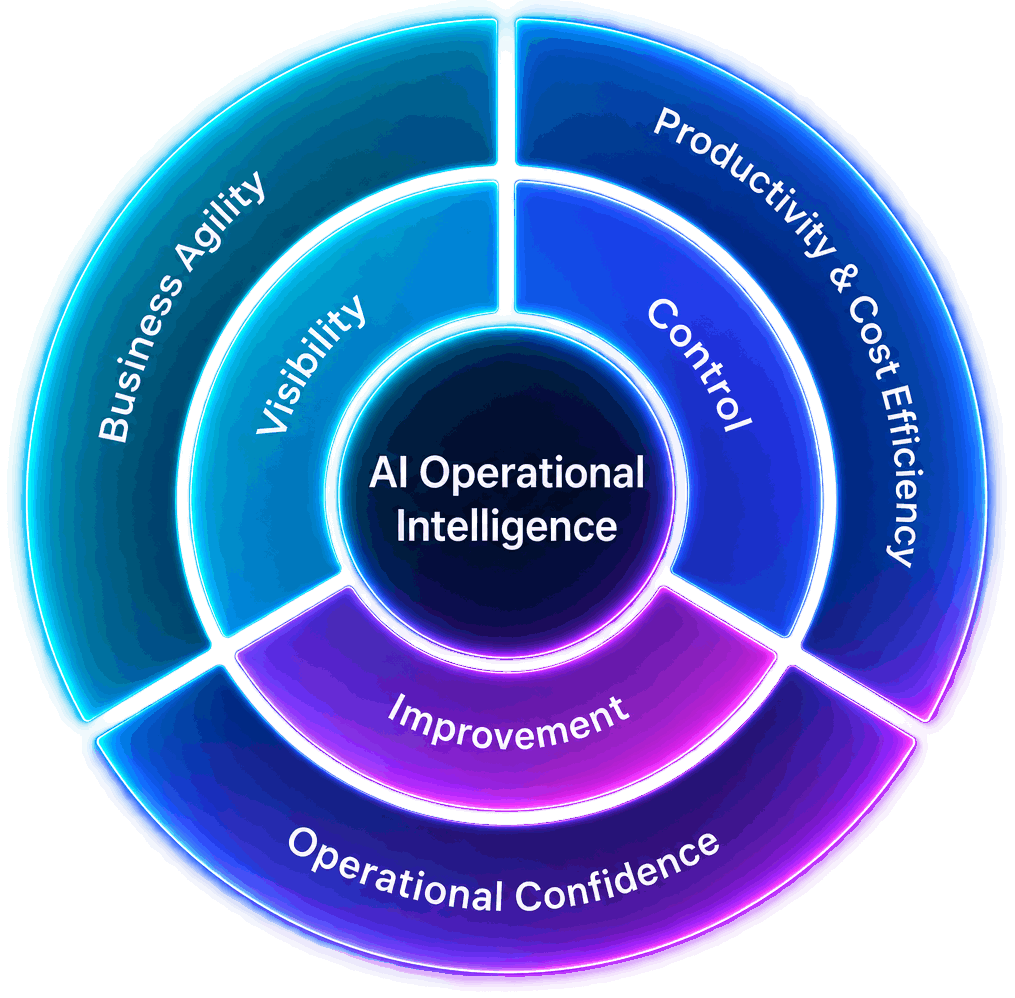
The Visibility Gap
When AI Adoption Outpaces Operational Understanding
The more AI becomes part of everyday business, the harder it can be to see the complete picture.
Artificial intelligence is increasingly embedded in business operations, from customer communications and content production to software development, data analysis and automated workflows.
Yet adoption often happens incrementally. Different teams introduce different tools, subscribe to separate services and develop their own ways of working. Individual applications may perform well, while the organisation lacks a clear understanding of their combined cost, effectiveness and operational impact.
The challenge isn't simply a lack of data. It's the difficulty of connecting technical activity with business context. Organisations need information they can interpret, compare and act upon, with a clear understanding of the assumptions, risks and opportunities involved.
More dashboards don't necessarily mean better decisions.
Dashboards alone cannot close the visibility gap created by rapid AI adoption. Reporting shows what's happening, but effective operational intelligence connects that information with governance, performance and the business decisions that follow.
That's where AI Operational Intelligence becomes valuable.
AI is growing faster than management visibility, creating questions that traditional reporting may struggle to answer.
Where is our AI investment going?
Expenditure can be spread across providers, subscriptions, departments and individual projects, making the true cost difficult to establish.
Are we using the right technology for each task?
More expensive or powerful AI models are not necessarily the best choice for every application. Cost, quality, speed and reliability all matter.
How do we know whether AI is delivering value?
Usage statistics may show activity without revealing whether it improves productivity, reduces errors or contributes to business objectives.
Who is responsible for oversight and control?
As AI becomes embedded in processes, organisations need appropriate policies, permissions, accountability and visibility into how systems are being used.
Can we anticipate tomorrow's requirements?
Historical spending figures provide useful information, but offer limited guidance about the consequences of increased demand, new projects or changes in technology.
From Visibility to Informed Action
Understand. Evaluate. Decide.
This is the framework. It provides control + insight — a practical approach to making AI work better for your business. Where first, you understand the present. Next, you evaluate the possibilities. Lastly, you decide what comes next. Try clicking each of the three cards below to read more about each stage of the decision-making process. It's a continuous cycle of measurement, evaluation and improvement.
Understand: Know What's Happening
Before an organisation can improve its AI operations, it needs a reliable picture of its current position.
Which systems and models are being used? By whom, for what purpose and at what cost? How are they performing? What risks or limitations are emerging?
This means looking beyond individual applications to understand how AI fits within the wider business, including its people, processes, responsibilities and objectives.
Evaluate: Explore What Could Work Better
Visibility provides the starting point. Evaluation turns information into useful intelligence.
Could another model perform a task more economically? Would a different workflow improve reliability? How might increasing AI demand affect expenditure? Would stronger controls reduce operational risk?
By comparing alternatives, examining trade-offs and exploring possible scenarios, businesses can assess opportunities before committing resources or changing established processes.
The objective isn't simply to find the cheapest solution. It's to identify options that offer the most appropriate balance of cost, quality, performance, risk and business value.
Decide: Turn Intelligence into Action
Information alone doesn't improve a business. Decisions and the actions that follow do.
Armed with clearer evidence, managers can determine where to invest, what to change, which risks to address and where existing systems are already performing effectively.
Some decisions may lead to automation or revised operating policies. Others may require changes to processes, training or technology. Sometimes the right decision is to leave a system alone.
Once a decision is implemented, measure
its results against expectations.
Did costs fall? Was quality maintained?
Did productivity improve? Were new risks
introduced?
The feedback loop:
What you learn becomes the starting point
for the next Understand stage, creating a
continuous cycle of improvement.
↺ The results feed into the next decision cycle.
Intelligence with a business purpose
Better AI Operational Intelligence
For Your Business
The value isn't more information. It's what you can do with it. Every business has different priorities. Some need to control rapidly increasing AI expenditure. Others need greater confidence in how AI is being used, stronger operational performance, or better information before making their next investment. AI Operational Intelligence can help address these challenges in practical ways.
Make More Informed Technology Choices
Not every AI task requires the same model, provider or level of computing capability.
Understanding the relationship between cost, performance and suitability can help organisations identify where alternative approaches may deliver comparable or improved results.
The goal is to choose technology according to the requirements of the task, rather than habit, assumption or price alone.
Understand and Anticipate AI Expenditure
Knowing what AI cost last month is useful. Understanding what it may cost next quarter is invaluable.
By examining usage patterns, projected demand and alternative operating scenarios, businesses can develop a clearer picture of future expenditure and potential financial exposure.
Forecasts are estimates, not guarantees, but they can support more informed budgeting, investment and capacity decisions.
Strengthen Governance & Operational Oversight
As AI takes on more responsibilities, organisations need to know that its use remains consistent with their policies, obligations and acceptable levels of risk.
Appropriate monitoring, access controls, auditability and human oversight help management retain accountability while benefiting from automation.
Effective governance should support responsible innovation, not unnecessarily obstruct it.
Identify Opportunities for Greater Efficiency
Operational intelligence may reveal repeated work, unnecessary model expenditure, inefficient processes or opportunities to simplify existing systems.
Some improvements may involve relatively small adjustments. Others may justify redesigning a workflow or introducing new technology.
The objective is sustainable improvement, not change for its own sake.
Connect AI Activity to Business Value
AI usage is not the same as AI success. The more important questions concern outcomes:
whether a process takes less time, customers receive better service, work becomes more reliable or employees can focus on higher-value activities.
By connecting operational measures with meaningful business objectives, organisations can develop a more realistic understanding of the value their AI investments are producing.
Build Greater Operational Confidence
AI is evolving quickly, and organisations need to make decisions about technologies, expenditure and processes in circumstances that are constantly changing.
Better operational intelligence helps reduce uncertainty by giving managers a clearer understanding of how their AI systems are performing, where potential problems may emerge and what the consequences of different choices could be.
The result is a stronger foundation for planning, investment and continuous improvement, with decisions informed by evidence rather than assumptions alone.
Putting Operational Intelligence into practiCe
From Operational Insight to Intelligent Systems
Better decisions need reliable information. Turning that information into useful intelligence requires the right systems working together. AI Operational Intelligence isn't a single application or piece of hardware. It's an approach that connects information about AI activity with the tools, controls and business understanding needed to evaluate performance and support informed decisions.
In practice, this involves three connected capabilities:
01 / Connect and Observe
Bring together relevant information from AI models, applications, agents, workflows and existing business systems.
This establishes visibility into how AI is being used, what it costs, how it performs and where risks or inefficiencies may emerge.
02 / Analyse & Govern
Use monitoring, evaluation, forecasting and appropriate controls to turn operational information into intelligence that people can understand and act upon.
The objective is to identify meaningful patterns, compare alternatives, understand trade-offs and maintain oversight.
03 / Inform Action & Improvement
Present the evidence in ways that help people decide what to change, where to invest and what to monitor.
Software and automation can support approved actions, while ongoing measurement provides feedback about what those decisions actually achieve.
ModelSpend: AI Operational Intelligence in Practice
Twizu's approach to AI Operational Intelligence is reflected in ModelSpend, our own purpose-built AI governance and financial intelligence software.
ModelSpend brings together intelligent model routing, expenditure visibility, governance controls and predictive financial intelligence to help organisations understand and manage their AI operations. It connects operational activity with financial insight, supporting better-informed decisions about cost, performance, risk and future AI investment.
ModelSpend has been built as a distinct software product, with its own identity, website and commercial offering. Its interactive Mission Control demonstration provides an opportunity to explore the product experience using simulated data.
Discover the story behind ModelSpend at Twizu →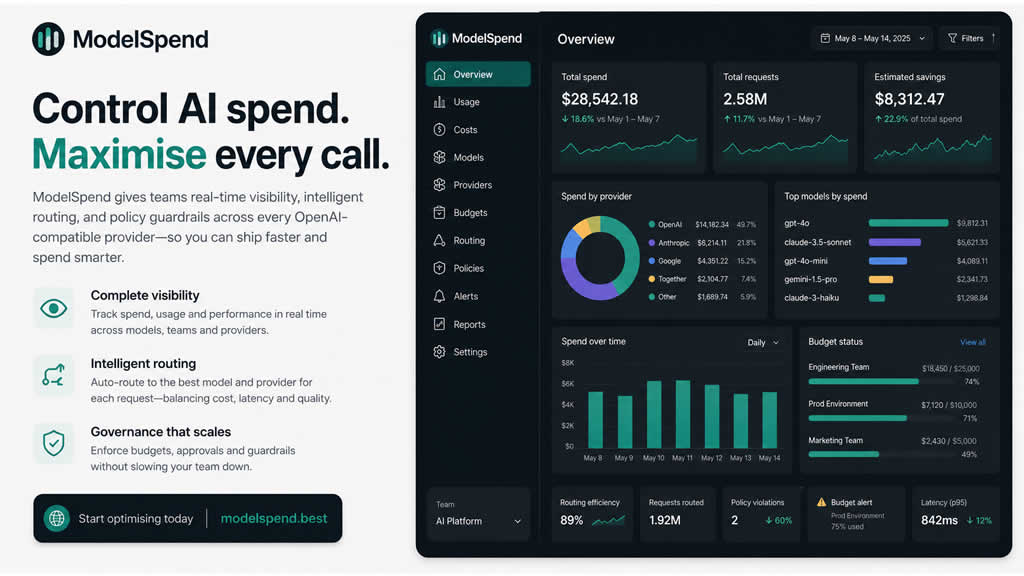
Need a tailored solution?
Explore how Twizu engineers and integrates AI software around your business requirements.
Explore ModelSpend
Discover our AI governance and financial intelligence product, or explore the simulated Mission Control experience.